DISC Personality Test: Find Your D, I, S or C Style
The DISC test shows how you tend to behave at work across four styles: Dominance, Influence, Steadiness and Conscientiousness. This one has 32 short statements and takes about five minutes, or 16 in quick mode. You get a percentage for each style, your primary and secondary style, a share card and a way to compare with a teammate.
Free · no sign-up · answers never leave your device
Optional after your free result: the DISC Full Report PDF, 30+ pages, $14.90 one-time (first 3 pages free to preview; no subscription, no auto-renew, lifetime access), or every report for $29. Pricing
What the DISC test measures
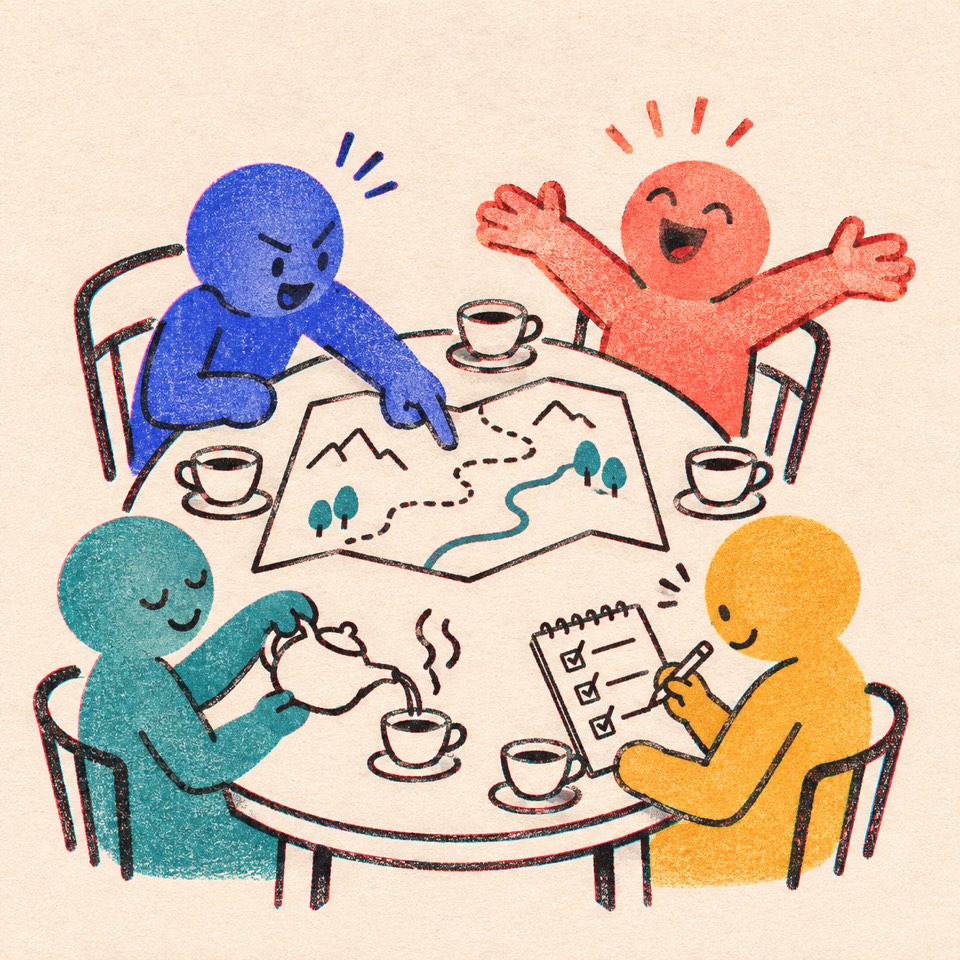
DISC is a behaviour-style model that sorts everyday work habits into four groups. Dominance is about how directly you take charge and push for results. Influence is about how you connect, persuade and bring energy to people. Steadiness is about patience, consistency and support. Conscientiousness is about accuracy, analysis and standards.
Everyone has some of all four. The useful part is the shape of your profile: which styles are loud, which are quiet and how they combine. A high D with a high C works very differently from a high D with a high I, even though both lead with Dominance.
Where DISC comes from
The four-part idea goes back to the American psychologist William Moulton Marston, who described it in his 1928 book Emotions of Normal People. He wrote about how people respond to their environment, depending on whether they see it as favourable or hostile and whether they see themselves as stronger or weaker than it. He did not build the questionnaires used today; those were developed later by other people.
So DISC is an old, popular framework, not a precise laboratory measurement. We use it because it is simple, practical and easy to talk about in teams. Treat your result as a prompt for reflection rather than a verdict.
How the test and scoring work
You rate 32 original statements about your behaviour at work and in daily life, from strongly disagree to strongly agree. Eight statements cover each style, and a few are reverse-worded to reduce yes-saying. Quick mode uses a shorter set of 16, which is faster but gives a rougher picture.
Your answers are added up for each style and turned into a percentage for D, I, S and C. The highest becomes your primary style and the next one your secondary style. Your answers stay in your browser, and you do not need an account or an email address to see the full result.
How to read your results
Start with your primary and secondary style, then read the full page for each. Look at the gaps: a style far above the others is a strong habit, while styles that sit close together mean you flex between them. A low score is not a weakness. It simply means that behaviour is less natural for you.
Use the share card to show friends or colleagues your profile, and the teammate comparison to see where your styles meet or clash. The most helpful question is often practical: given our two profiles, how should we communicate and divide work?
Accuracy, limits and paid alternatives
This is a self-report test, so it reflects how you see yourself today, and your answers may change with your role, mood or the people around you. DISC is a behaviour-style model. It is not a clinical assessment, it cannot diagnose anything and it should not be used to hire, promote or reject anyone.
Paid commercial DISC assessments also exist, usually sold through certified providers with longer reports and facilitated workshops. If you need a formal team programme, those may suit you. Our version is a free, quick starting point for self-awareness, with no email and no sign-up.
FAQ
How long does the DISC test take?
The full test has 32 statements and takes about five minutes. Quick mode has 16 statements and takes roughly half that, with a rougher result. You can choose either at the start, and you can retake the test any time to see how your answers change.
Is this DISC test really free?
Yes. You can take the test, see all four percentages, read your primary and secondary style and use the share card and teammate comparison without paying and without giving an email address. Paid assessments from other providers exist, but you do not need one to use this test.
What do the D, I, S and C stand for?
D is Dominance, I is Influence, S is Steadiness and C is Conscientiousness. Each describes a cluster of behaviour at work. Dominance is direct and results-driven, Influence is social and persuasive, Steadiness is patient and supportive, and Conscientiousness is careful and analytical. Most people show a blend of all four.
Can I use DISC for hiring or career decisions?
We would not. DISC is a behaviour-style model for self-reflection and team communication. It does not measure skill, intelligence, mental health or job performance, and it is not designed for screening candidates. Use your results to understand yourself, and rely on skills, experience and interviews for decisions about people.
How is this different from the official DISC assessments?
Official commercial assessments are sold by publishers with their own questions, scoring and reports. This test uses original statements written for Traitprint and gives a simpler result. The model itself is public domain, but the results are not interchangeable with a paid publisher report, so expect some differences.
Can I compare my result with a teammate?
Yes. After you finish, you can share a link to your profile and compare it with a colleague, friend or partner who has taken the test too. The comparison shows where your styles overlap and where they differ, with simple tips for communicating and splitting work.
Is my data stored, and who owns DISC?
Your answers stay in your browser, and we do not ask for an email. DISC is not owned by us; as the note says, DISC is a public-domain behaviour model. Traitprint is not affiliated with Wiley, Everything DiSC® or any assessment publisher.
Is there a full DISC report as a PDF?
Yes, optionally. The free result stays free. Under it you can download the first 3 pages of the DISC Full Report for free, then buy the whole PDF (30+ pages, written for your exact scores, with a 30-day plan and worksheets) for $14.90 once. It is not a subscription and never renews, and you can re-download it any time. Every full report, the IQ certificate + report and all deep reports together cost $29 once.
For self-reflection and entertainment only — not a clinical or diagnostic assessment.
Enneagram Test
Find your Enneagram type and wing out of nine core motivations.
90 questions · ~9 min · free
PersonalityBig Five Personality Test
Openness, conscientiousness, extraversion, agreeableness and neuroticism — the model psychologists use.
50 questions · ~6 min · free
RelationshipsLove Language Test
Which of the five love languages fills your cup — and how it compares with your partner's.
30 questions · ~5 min · free