EQ Test: How Emotionally Intelligent Are You?
This free EQ test uses 30 short statements to estimate your emotional intelligence across five areas: self-awareness, managing emotions, motivation, empathy, and relationship skills. It takes about five minutes, or half that in quick mode with 15 statements. You get an overall score from 0 to 100, a score for each area, and practical tips, with no sign-up.
Free · no sign-up · answers never leave your device
Optional after your free result: the EQ Full Report PDF, 24+ pages, $14.90 one-time (first 3 pages free to preview; no subscription, no auto-renew, lifetime access), or every report for $29. Pricing
What this EQ test measures
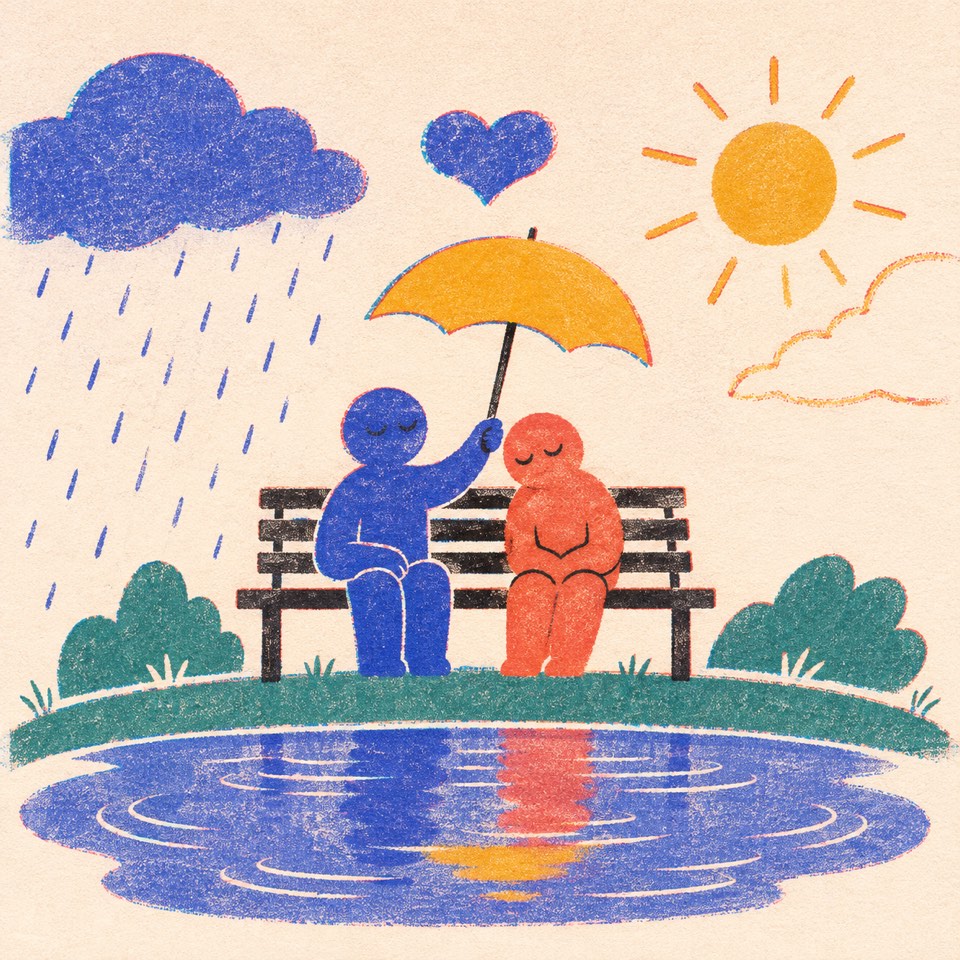
Emotional intelligence, often shortened to EQ, is how well you notice, understand, and handle emotions, both your own and other people's.
This test splits EQ into five areas. Self-awareness is noticing what you feel and why. Managing emotions is staying steady and recovering after a bad moment. Motivation is your drive, persistence, and ability to bounce back from setbacks. Empathy is sensing what others feel. Relationship skills are how you communicate, handle conflict, and build trust.
How the scoring works
You rate 30 everyday statements on a five-point scale from strongly disagree to strongly agree. Six statements cover each of the five areas, and a couple in each area are worded in reverse so that agreeing with everything does not push your score up.
Each area is converted to a score from 0 to 100, and your overall EQ score blends all five. Your result names your strongest and weakest area and gives one practical tip for each. You can also save a share card or compare results with a friend.
Self-report tests versus ability tests
Psychologists tend to study emotional intelligence in two ways. Ability tests give you problems with better and worse answers, such as judging which emotion a face shows or which response would calm a situation. Trait or self-report tests, like this one, ask how you usually think, feel, and act, and treat your answers as a picture of your emotional habits.
Both approaches have trade-offs. Self-report is quick, private, and easy to take at home, but it depends on how well you know yourself and how honest you want to be. Paid EQ assessments exist for people who want a detailed report or a facilitated debrief.
How to read your score
Treat your result as a snapshot of how you see yourself today, not a fixed trait. Self-report also has a built-in bias: people who are very self-critical may score lower than their friends would rate them, and people who are less aware of their blind spots may score higher.
The most useful number is often the gap between your areas rather than the total. If your empathy score is high but relationship skills are lower, you may understand people well but find it hard to say difficult things out loud.
How to improve each area
For self-awareness, pause once or twice a day and name what you feel in one word, then guess what triggered it. For managing emotions, build a short reset habit, such as a slow breath, a walk, or waiting before you hit send. For motivation, break big goals into small next steps and review what a setback taught you instead of what it says about you.
For empathy, ask one more question before offering advice and listen for the feeling behind the facts. For relationship skills, practice raising small issues early, using plain words like I felt and I need, and reaching out first after a disagreement.
This is a self-reflection tool, not a clinical or hiring assessment, and not a diagnosis. A score cannot tell you whether you have a mental health condition. If your emotions feel unmanageable or you are struggling, please talk to a licensed professional. In the US you can call or text 988 at any time to reach the Suicide and Crisis Lifeline. A self-reflection tool, not a clinical assessment or diagnosis. Original questions written by Traitprint.
FAQ
Is this EQ test really free?
Yes. The test and your full results cost nothing, and you do not need to create an account or enter an email address. Your answers stay in your browser while you take the test, and you can share or compare your result only if you choose to.
How long does the EQ test take?
The full version has 30 statements and takes about five minutes. If you are short on time, quick mode has 15 statements, three for each of the five areas, and takes around two or three minutes.
What is a good EQ score?
There is no pass or fail. A higher score means you describe yourself as using more of these emotional skills in daily life, and a lower score points to areas you might practice. Since this is a self-report snapshot, focus on your strongest and weakest areas and the tips rather than the single overall number.
Is emotional intelligence the same as IQ?
No. IQ is about reasoning and problem solving, while EQ is about handling emotions and relationships. They are different things, and one does not predict the other.
Can I improve my emotional intelligence?
Yes. These are skills, not fixed traits. Naming your feelings, pausing before you react, asking curious questions, and repairing conflicts early all get easier with repetition. Your result lists a practical tip for your weakest area, and retaking the test after a few months can show whether your habits are shifting.
Is this a clinical or hiring assessment?
No. It is a self-reflection tool built on original questions written by Traitprint, not a clinical assessment, a diagnosis, or a hiring screen, and it should not be used to judge anyone. If emotions feel unmanageable, talk to a licensed professional, and in the US you can call or text 988.
Can I compare my EQ result with a friend?
Yes. After you finish, you can save a share card or send a link so a friend can take the same test and see both results side by side.
Is there a full EQ report as a PDF?
Yes, optionally. The free result stays free. Under it you can download the first 3 pages of the EQ Full Report for free, then buy the whole PDF (24+ pages, written for your exact scores, with a 30-day plan and worksheets) for $14.90 once. It is not a subscription and never renews, and you can re-download it any time. Every full report, the IQ certificate + report and all deep reports together cost $29 once.
For self-reflection and entertainment only — not a clinical or diagnostic assessment.
Enneagram Test
Find your Enneagram type and wing out of nine core motivations.
90 questions · ~9 min · free
PersonalityBig Five Personality Test
Openness, conscientiousness, extraversion, agreeableness and neuroticism — the model psychologists use.
50 questions · ~6 min · free
RelationshipsLove Language Test
Which of the five love languages fills your cup — and how it compares with your partner's.
30 questions · ~5 min · free